
You leave home looking fresh and ready for work. Your earrings shine. Your pendant sits neatly over your kurta or shirt. By lunch, the day feels warmer. You have walked to the metro, waited for a cab or moved between meetings. A little sweat gathers near your neck and ears.
Then you remember the last necklace you loved. It looked beautiful for a few days, but soon became dull and dark. You stopped wearing it.
Does that story sound familiar?
You are not alone. If you are searching for office jewellery that doesn’t turn black from sweat, you are really looking for a piece that can handle normal moisture, heat and daily wear without losing its finish too quickly.
Heat, humidity, sweat, perfume and regular use can be hard on fashion jewellery. But this does not mean you must choose between style and comfort.
You can find office jewellery that resists sweat and keeps its finish for longer. You only need to know what to check before buying and how to care for it after wearing.
This guide will help you choose anti-tarnish office jewellery for Indian weather and a busy workday. You will learn why jewellery turns black, which materials and finishes may last longer, what “anti-tarnish” really means and how to protect your favourite pieces.
“Good office jewellery should work with your day, not make your day harder.” — Orika Jewels
Key takeaways
- Sweat-resistant jewellery is less likely to become dull or dark, but no fashion jewellery is completely care-free forever.
- The base metal, plating, protective coating, product quality and your care routine all matter.
- Stainless steel is often a practical choice for daily wear.
- Coated brass, sterling silver and other alloys can also work when the product is well made and cared for correctly.
- Choose light, smooth and simple pieces for long office hours.
- Wipe your jewellery after wearing it and store every piece dry and separately.
- Check the product page for material, finish, care instructions and warranty before buying.
Why does office jewellery turn black from sweat?
Jewellery does not usually turn dark for only one reason. Several small things work together.
1. Sweat leaves moisture and salts on the surface

Sweat is not only water. It also contains salts and other substances. When it stays on metal for many hours, it can affect the surface or plating.
A study on stainless steel in artificial sweat found that more acidic sweat increased corrosion. Even strong metals can react under certain conditions. This is why “sweat-resistant” is a more honest term than “impossible to tarnish.”
Your sweat can also be different from another person’s sweat. Weather, skin products, activity and body chemistry can change the result.
One person may wear a piece for months with little change. Another person may notice fading sooner.
2. India’s heat and humidity add more moisture
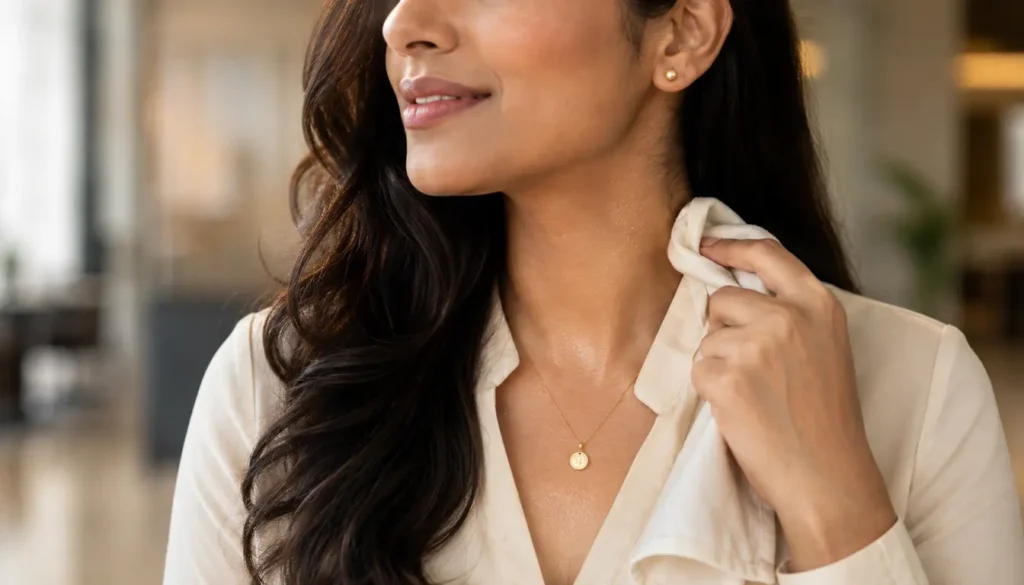
Many parts of India stay hot or humid for long periods
Your jewellery may face sweat during travel, outdoor meetings or power cuts. Moisture can speed up changes on some metals. The Canadian Conservation Institute also notes that moisture and salts can support corrosion on metal objects.
This does not mean you cannot wear jewellery during summer. It means that the material, coating and care become more important.
3. Perfume, cream and hair products touch the jewellery
Perfume, moisturiser, sunscreen, foundation, hair spray and sanitiser may contain alcohol, oils, acids or other ingredients.
When these products sit under a chain, ring or earring, they may weaken a plated finish over time.
Put your beauty products on first. Let them dry. Wear your jewellery last.
4. Friction slowly wears the outer finish
A chain may rub against your neck, collar, dupatta, handbag strap or office ID card. A ring touches your desk, keyboard, files and door handles. A bracelet moves across your wrist all day.
This daily rubbing can slowly wear down the top layer.
The base metal may then become more visible. This can look like fading, darkening or a colour change.
5. Poor storage keeps moisture trapped
Putting a sweaty necklace straight into a closed box can trap moisture.
Keeping many pieces together can also cause scratches. Dust can hold moisture and pollutants against metal. Over time, the finish may become dull.
Always wipe the piece first. Let it become fully dry. Then store it in a clean pouch or separate section of your jewellery box.
What does anti-tarnish jewellery really mean?
Anti-tarnish jewellery is made to resist dullness, dark marks and colour changes for longer than ordinary fashion jewellery.
The resistance may come from the base metal, plating method, protective coating or a mixture of these things.
Anti-tarnish does not always mean:
- The jewellery can stay in water all day.
- Perfume and chemicals can never affect it.
- The colour will remain unchanged forever.
- Every item is suitable for every sensitive skin type.
- No care is required.
The words “anti-tarnish” should describe better resistance under normal use. They should not be used as a magic promise.
Some jewellery has a clear protective layer, such as e-coating. Some jewellery uses a decorative coating made through physical vapour deposition, often called PVD.
A scientific review describes PVD as a process used to create decorative and protective hard coatings.
However, the final result still depends on the complete product. This includes the metal grade, surface preparation, coating quality, thickness, design, handling and care.
“Anti-tarnish does not mean no-care. It means better resistance with the right material, finish and habits.” — Orika Jewels
When shopping, look beyond the headline. Read the complete product details.
A trustworthy seller should tell you the material and provide clear care instructions.
Which jewellery materials are better for sweat and daily office wear?
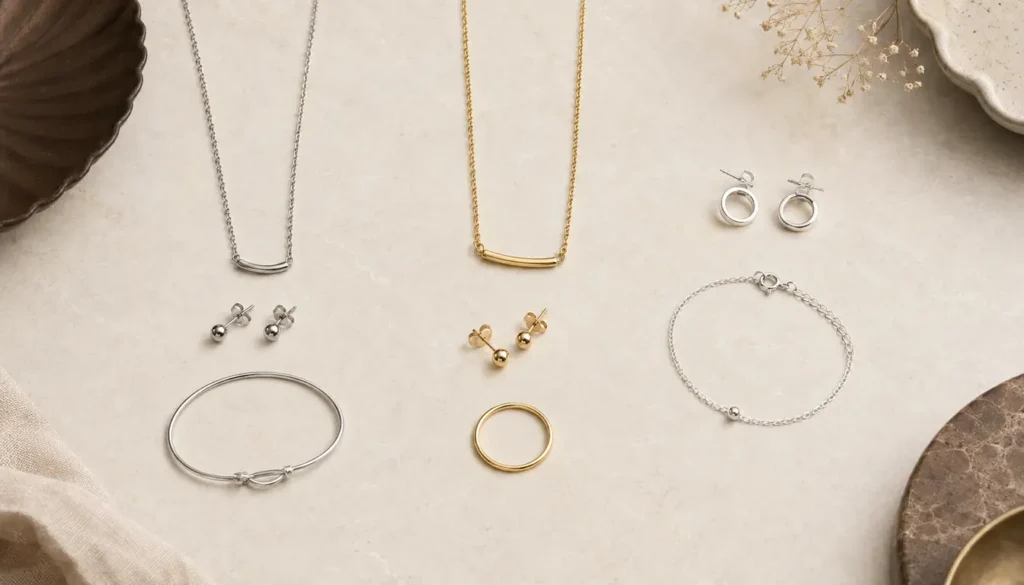
There is no single material that is best for every design, budget and person. Here is a simple comparison.
Stainless steel jewellery
Stainless steel is a popular choice for daily-wear jewellery because it is strong and generally resists corrosion better than many common base metals.
It can work well for chains, pendants, bracelets, rings and simple earrings.
Working women may like stainless steel jewellery because:
- It is strong enough for regular use.
- It usually needs simple care.
- It can hold clean and modern shapes.
- It may resist moisture better than low-quality plated alloys.
- It works well for minimal office styles.
However, “stainless” does not mean “cannot stain.”
Research on stainless steel in artificial sweat shows that the metal grade and conditions matter. The colour coating on gold-tone stainless steel can also wear if it faces chemicals, scratches or heavy rubbing.
Do not assume that every stainless steel item is nickel-free or suitable for sensitive skin. Check the exact product information. Skin reactions differ from person to person.
Brass jewellery with good plating and coating
Brass is commonly used in fashion jewellery because it can be shaped into detailed and elegant designs.
It can give you a premium appearance at an accessible price. You may see brass used in earrings, pendants, mangalsutras, rings and statement pieces.
Brass contains copper and zinc. Copper-based metals can change colour when exposed to moisture, salts or sulphur compounds.
A strong plated layer and protective top coat can slow this process. But once the top layer wears down, the brass below may react more easily.
Choose brass jewellery when:
- The product has clear plating and coating information.
- You want a more detailed or decorative design.
- You can remove it before bathing, swimming or heavy exercise.
- You are ready to follow the care instructions.
- The seller provides clear support or a warranty.
Sterling silver jewellery
Sterling silver can be elegant, valuable and comfortable for many people. But it can still tarnish.
Silver often becomes dark when it reacts with sulphur-containing compounds in the air. The dark layer is commonly called silver sulphide.
The good news is that silver tarnish can often be cleaned using the correct method.
However, do not use a harsh cleaner without checking whether the item has stones, plating or another special finish.
Sterling silver may suit you if you like real silver, accept that it may need cleaning and prefer a classic look for work.
Alloy jewellery
“Alloy” means a mixture of metals. The word does not tell you the complete quality of a product.
One alloy product may perform well, while another may fade quickly. The coating and quality control matter greatly.
Before buying alloy jewellery, check:
- What material information is provided.
- Whether the product is plated or coated.
- What care is required.
- Whether skin-safety claims have reliable support.
- Whether return and warranty terms are clear.
Gold-plated jewellery
Gold-plated jewellery has a thin gold-coloured layer over another metal. It gives you a premium look without the price of solid gold.
However, the top layer can wear after regular contact with sweat, chemicals and friction.
The phrase “18K gold plated” describes the outer layer or its colour. It does not tell you everything about durability.
The plating thickness, method, base metal and protective coating also matter.
For office wear, gold-plated jewellery can be a lovely choice when it is well made and worn with care.
Apply perfume first, keep the jewellery away from harsh chemicals and wipe it after use.
How to choose office jewellery that does not turn black quickly
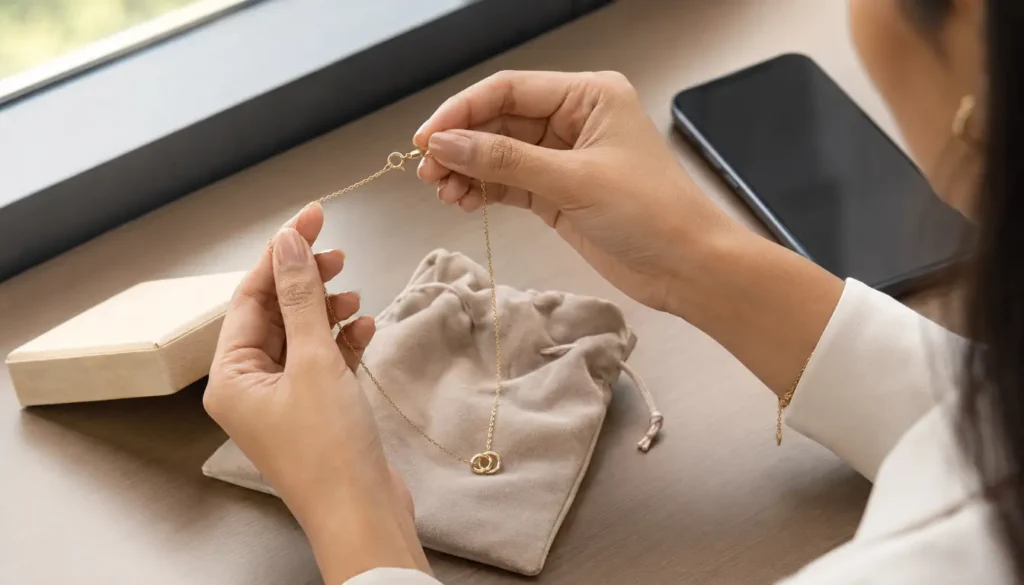
You do not need to be a metal expert. Use this simple buying method.
Check the base material
Look for clear words such as stainless steel, brass, sterling silver or alloy.
Avoid listings that only say “premium quality” without explaining what the jewellery is made from.
Check the finish or protective layer
Look for information about plating, e-coating, PVD or another finish.
A coating can help protect the surface, but it is not a reason to ignore proper care.
Read the care instructions
Good product pages tell you what to avoid.
If a seller says a piece is anti-tarnish but provides no material or care information, ask questions before buying.
Understand water-related claims
“Waterproof,” “water-resistant” and “sweat-resistant” may be used differently by different sellers.
Ask what normal use includes:
- Does it mean a little sweat or rain?
- Can you wear it in the shower?
- What about chlorine or salt water?
- What about soap and hot water?
For fashion jewellery, the safest habit is to avoid long water exposure unless the product page clearly allows it.
Dry the item soon after accidental contact with water.
Look for a useful warranty
A warranty shows that the brand has set a product standard.
Read what the warranty covers, how long it lasts and what proof may be needed. Check what is excluded, such as scratches, breakage, chemical damage or misuse.
Choose comfort for long workdays
The best office jewellery is not only about shine. It should feel easy after eight or ten hours.
Look for:
- Light earrings that do not pull your ears.
- Smooth edges that do not catch on clothes.
- Secure clasps.
- Adjustable chains and bracelets.
- Rings that do not disturb typing.
- Pieces that do not make too much sound.
Read reviews carefully
Do not only look at star ratings.
Read what buyers say after several weeks or months. Search for comments about colour, comfort, clasps, skin marks, packaging and customer support.
Photos and videos can help, but remember that lighting can change colour. Check the written product information too.
Best sweat-resistant jewellery styles for the office
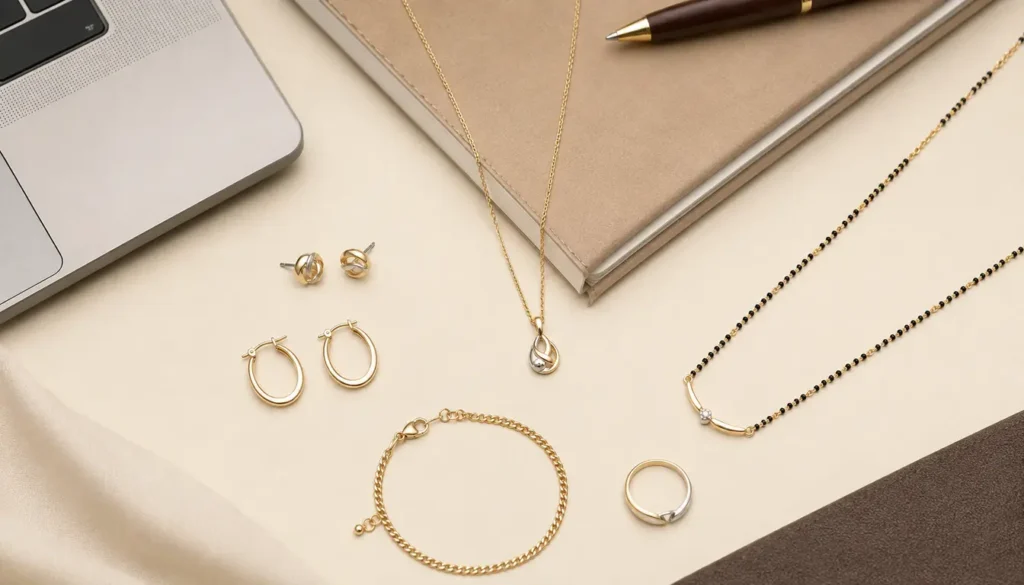
Office jewellery should add polish without making your outfit feel heavy.
These styles are easy to repeat through the week.
Small studs
Studs are simple, neat and easy to wear.
They work with formal shirts, kurtas, sarees and dresses. Choose smooth shapes that will not catch on your hair or headset.
Slim hoops
Small or medium hoops can make a basic outfit feel modern.
Avoid very heavy hoops for long working days. A secure closure is important if you travel by metro, bus or two-wheeler.
Delicate pendant necklaces
A short, light pendant adds interest near your face.
It can sit well over a plain shirt, kurta or round-neck top. If you sweat around your neck, wipe the chain as soon as you return home.
Simple chain bracelets
A slim bracelet looks polished with rolled-up sleeves.
Make sure it does not hit your desk or keyboard repeatedly. A smooth design is easier for daily work.
Minimal rings
Choose a ring that lets you type, write and carry files without trouble.
A low and smooth design will face less impact than a large raised stone.
Lightweight mangalsutras
A small office-wear mangalsutra can bring cultural meaning into a clean and modern look.
Choose a length and pendant size that do not feel heavy during travel or work.
One-piece office statements
You can wear one stronger piece and keep everything else simple.
For example, pair neat jhumkas with no necklace. You could also wear one bracelet with small studs.
Vogue India’s office styling guidance supports using one clear jewellery focus with clean workwear.
This “one focus” rule helps your outfit look polished instead of crowded.
A simple care routine that helps jewellery last longer
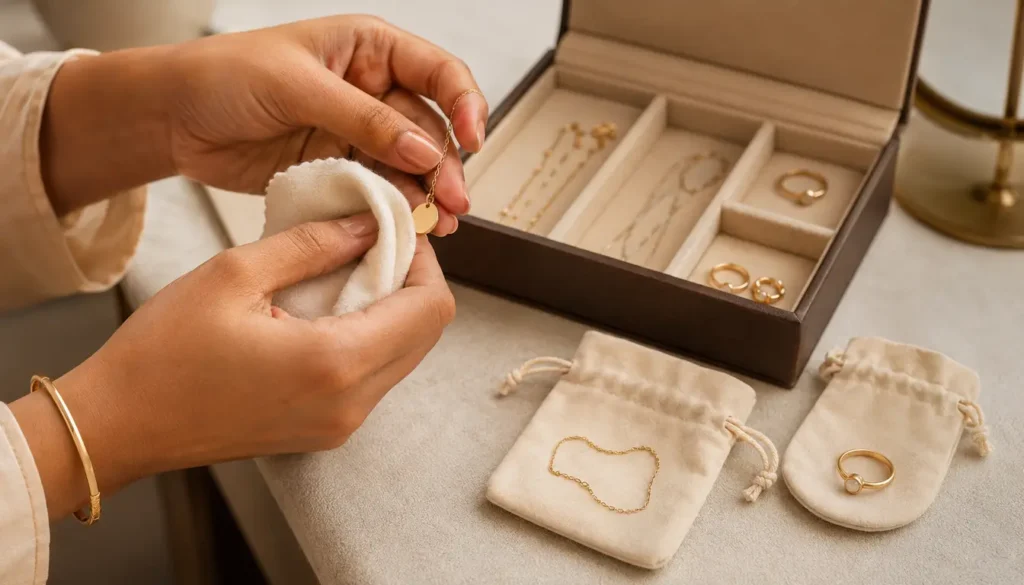
A good material can still lose its finish when treated badly.
A simple routine can make a big difference.
Before leaving for work
- Apply moisturiser, sunscreen, perfume and hair products first.
- Let them dry for a few minutes.
- Put on your jewellery last.
- Check that clasps and earring backs are secure.
During the day
- Do not spray perfume over your necklace or earrings.
- Remove rings before using strong cleaning products.
- Keep jewellery away from sanitiser when possible.
- If you sweat heavily, gently dab the skin and jewellery with a clean, soft cloth.
- Do not rub the plated surface hard.
After returning home
- Remove the jewellery before bathing, exercising or sleeping.
- Wipe it with a clean, dry and soft cloth.
- Let any remaining moisture dry in the open for a short time.
- Store every piece separately.
Once a week
Check the clasps, stones, hooks and chains.
Remove light dust using a soft cloth. Do not use toothpaste, bleach, harsh polish or a rough brush. These things can scratch the finish.
If the product requires deeper cleaning, follow the brand’s instructions. Different metals, stones and coatings need different care.
Better storage for Indian weather
Use a dry pouch, small zip bag or divided jewellery box.
Keep the box away from bathrooms, kitchen windows and direct sunlight. Never store jewellery while it is wet.
You may use an anti-tarnish strip or a small moisture-control sachet if the seller says it is suitable.
Keep sachets away from children. Do not let them rub against delicate jewellery surfaces.
“The best daily-wear piece is the one you can wear with confidence and care with ease.” — Orika Jewels
Common myths about jewellery, sweat and tarnish

Myth 1: Anti-tarnish means the colour can never change
Truth: Anti-tarnish means that the piece is designed to resist tarnish better. Wear, chemicals, scratches and poor storage can still affect it.
Myth 2: Stainless steel can never react
Truth: Stainless steel is usually strong and corrosion-resistant, but its grade, coating and surrounding conditions matter. Even stainless steel can face surface changes after harsh or long exposure.
Myth 3: If jewellery turns black, it must be fake
Truth: Many real metals can tarnish. Sterling silver, for example, can develop a dark surface layer. Tarnish alone does not prove whether a piece is real or fake.
Myth 4: Clear nail polish is the best protective coating
Truth: Home-applied nail polish can look uneven, peel, trap dirt or damage the finish when removed. Choose products made with proper protective coatings and follow the seller’s care advice.
Myth 5: Expensive jewellery needs no care
Truth: Price alone does not stop sweat, chemicals or scratches. Even precious-metal jewellery may need correct cleaning and storage.
Myth 6: “Skin-safe” means nobody can react
Truth: Skin sensitivity is personal. Material details and tested claims matter, but no general statement can promise the same result for every person.
Stop wearing a piece if it causes itching, burning, swelling or a rash. Seek medical advice if the problem is serious or does not settle.
What Orika Jewels looks for in everyday office jewellery
Orika Jewels is created for modern Indian women who want professional polish without extra effort.
Our focus is premium but accessible jewellery for the office, travel, daily plans and the move from work to dinner.
Our collection may include stainless steel, brass, alloy, sterling silver and other materials, depending on the design.
Selected pieces may use e-coating or another finish. The product page should always be your main guide for the item’s material, colour, finish and care.
Orika Jewels products are offered as anti-tarnish and carry a limited six-month anti-tarnish warranty. This is subject to the product details, normal use, proper care, proof of purchase and inspection.
The warranty is designed to provide useful support. It is not a promise against scratches, breakage, chemical exposure, heavy wear or misuse.
We also avoid treating all jewellery as automatically hypoallergenic, nickel-free or lead-free. These claims should only be made when the specific product has reliable support.
Our aim is simple: help you choose pieces that feel elegant, light, versatile and easier to maintain.
Try this five-minute test before wearing a new piece to work
A product can look lovely in a photograph but still feel wrong after a full day.
Test it at home before wearing it to an important meeting.
First, wear the piece for five minutes while moving normally. Turn your head, type on a keyboard, lift your handbag and adjust your dupatta or collar.
Check whether the chain catches, the earrings pull or the bracelet hits the desk.
Next, look at the closure:
- Can you open and close it without help?
- Does the earring back feel secure?
- Is an adjustable part likely to become loose?
Then think about your day.
A long commute may require smaller earrings. A day of presentations may suit one neat pendant.
If you work with children, machines, food or medical equipment, follow your workplace safety rules. Avoid jewellery that could get caught.
Finally, check your skin after the short trial.
A brief pressure mark may fade. However, itching, burning or swelling is a reason to remove the item.
Do not force yourself to keep wearing a piece only because it looks good.
This small test helps you choose jewellery for real life, not only for a mirror photograph.
Quick buying checklist
Before adding office jewellery to your cart, ask:
- Is the base material clearly listed?
- Is the plating or coating explained?
- Does the style look light and work-friendly?
- Are care instructions provided?
- Is the water or sweat claim clear and realistic?
- Is there a return, exchange or warranty policy?
- Do reviews discuss long-term use instead of only first-day shine?
- Will the piece work with at least three outfits you already own?
If most of your answers are yes, you are making a better-informed choice.
Conclusion
Finding office jewellery that does not turn black quickly from sweat is not about believing the biggest promise.
It is about choosing the right material, a good finish, an honest seller and a style that fits your real routine.
Stainless steel can be a practical option for daily wear. Well-coated brass, sterling silver and other quality materials can also serve you well.
No matter what you choose, perfume, sanitiser, trapped moisture and rough storage can shorten the life of the finish.
Buy with clear information. Wear the piece with comfort. Wipe it after use. Store it dry.
These small habits can help your office jewellery keep its shine for longer.
Your jewellery should not have to wait for a special day. It should move with you through meetings, commutes, coffee breaks and evening plans—with elegance that works with you.
Frequently asked questions
1. Which jewellery does not turn black from sweat?
Well-made stainless steel jewellery often resists sweat and tarnish better than many low-quality plated metals.
Jewellery with good plating and a protective coating may also last longer. However, no fashion jewellery should be treated as permanently immune to sweat, chemicals, scratches and wear.
2. Is anti-tarnish jewellery good for office use?
Yes. Anti-tarnish jewellery can be a practical choice for office use because it is designed to resist dullness and colour change.
Choose light pieces, check their materials and follow the care instructions.
3. Can I wear anti-tarnish jewellery every day?
You can wear many anti-tarnish pieces regularly if the product is designed for daily use.
Remove them before heavy exercise, bathing, swimming or using strong chemicals unless the product page clearly says those activities are allowed.
4. Does sweat turn gold-plated jewellery black?
Sweat can affect gold-plated jewellery over time.
Moisture, salts, perfume and friction may weaken the plated layer. A good coating and proper care can slow the change, but the finish may still wear with use.
5. Is stainless steel jewellery completely sweat-proof?
Stainless steel is generally corrosion-resistant, but “completely sweat-proof” is a strong promise.
The steel grade, colour coating, construction and surrounding conditions all matter. Clean and dry the piece after heavy sweating.
6. How do I stop my office necklace from turning black?
Apply perfume and cream before wearing your necklace.
Keep it away from sanitiser and harsh chemicals, wipe it after use and store it dry. Choose a necklace with clear material and coating details.
7. Why does jewellery leave a green or dark mark on my skin?
Some metals can react with sweat, skin oils or beauty products and leave a temporary mark.
A worn plated layer may expose the base metal. A mark does not always mean an allergy, but stop using the piece if you experience itching, swelling, pain or a rash.
8. Can I clean anti-tarnish jewellery with toothpaste?
It is better not to use toothpaste.
Toothpaste can be abrasive and may scratch plating or protective coatings. Use a soft, dry cloth and follow the care instructions for that product.
9. What office jewellery is best for long working hours?
Small studs, slim hoops, delicate pendants, smooth bracelets, low-profile rings and lightweight mangalsutras are good options.
Choose secure clasps, smooth edges and a weight that remains comfortable throughout the day.
10. How long does anti-tarnish jewellery last?
There is no single duration for every product.
It depends on the metal, coating, frequency of use, sweat, climate, care and storage. Check whether the seller provides a clear warranty and what the warranty covers.